Why Leaders Still Think HR Is a Speed Bump
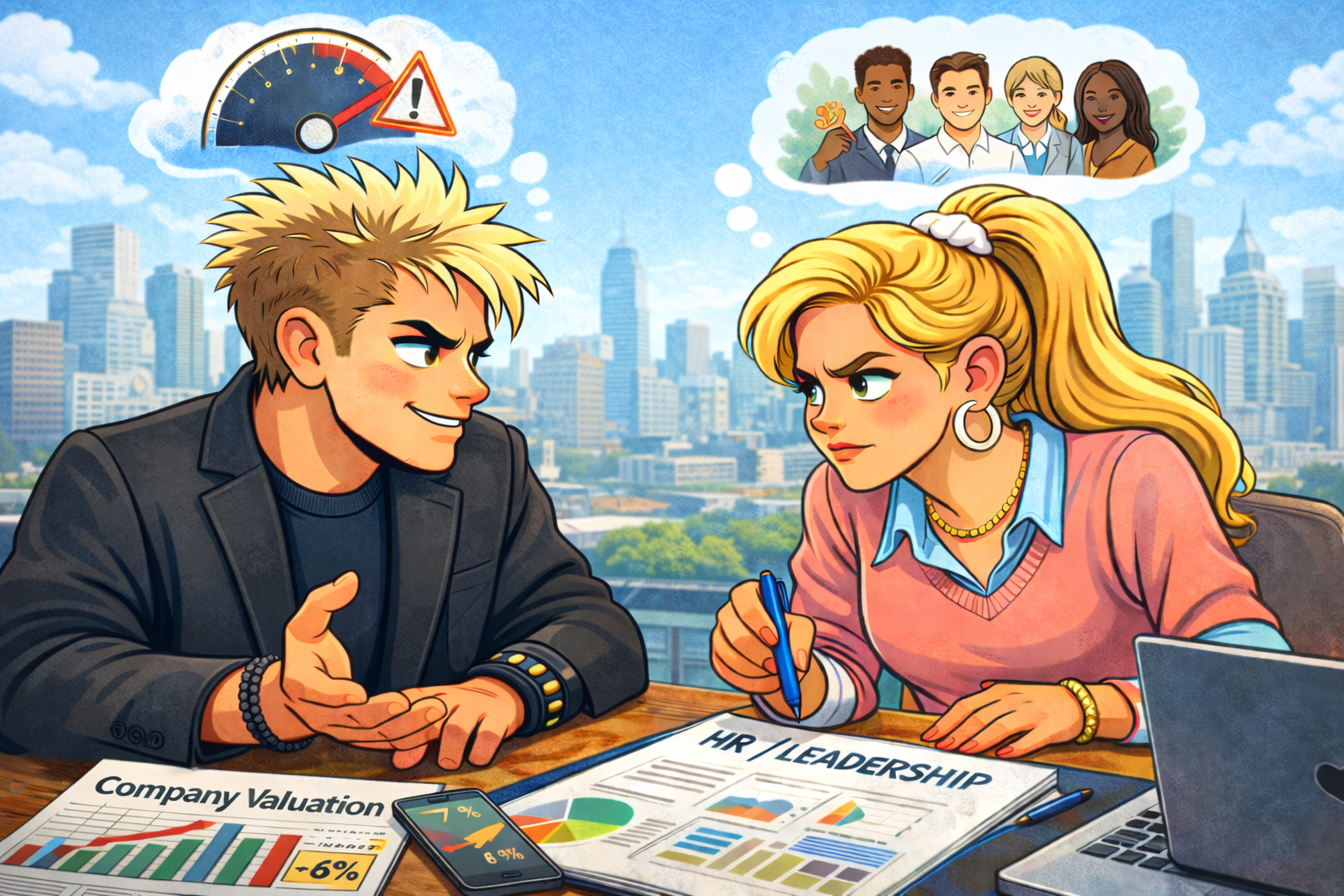
(Leadership Lens: Andrew Bloo | Strategic HR Lens: Reanette Etzler)
For decades, leadership culture has been conditioned to see HR as the brake pedal in a business obsessed with speed.
Leadership hits the gas.
HR reaches for the brakes.
And everyone pretends this tension is inevitable.
It isn’t.
But the belief runs deep – so deep that even many HR leaders have been forced into the role of “speed bump” on the raceway of progress, rather than recognized as a strategic partner in momentum.
HR leaders often cast themselves into this label due to the way they respond to what is happening. First, let me write you a citation for not checking in with HR first, then by saying “no” the law doesn’t allow that, and offering no solutions to actually help the manager resolve a situation that the manager may have even created. This creates the “speed bump.” Why do I go to HR? They don’t help me, they cause too many bumps in the road.
This piece explores where that conditioning came from, why it persists, and what actually changes when leaders stop treating HR as an obstacle and start treating HR as part of how progress is designed. And how HR can embrace the managers mistakes and turn them into opportunities for coaching.
The Problem Might Start With the Name
If leaders are honest, most don’t say HR is a speed bump.
They just lead like it is (It’s a hard truth).
The belief rarely sounds hostile. It’s quieter than that. More practical.
For many high-performance leaders, it starts with the name Human Resources.
Somewhere along the way, the “s” disappears.
Not resources.
Resource.
Singular. Supportive. Secondary.
In that mental model, HR isn’t positioned as part of how progress is designed. It sits adjacent to the work—important, but not essential to momentum. Helpful, but rarely decisive. Necessary, but not strategic in the way finance, operations, or product are.
That framing does real damage.
Once HR is understood as support instead of design, leaders don’t intentionally exclude it. They simply don’t reach for it early. Decisions get made. Timelines get set. Pressure gets applied. HR enters the picture after the human consequences start showing up.
Benefits administration. Policy interpretation. Cleanup work once something breaks under strain.
From the leadership side, it feels efficient. From the HR side, it feels familiar.
And when HR finally asks early-stage questions about capacity, sustainability, risk, or long-term impact, it doesn’t register as partnership. It feels like resistance. Like something slowing things down.
That’s the moment HR earns the label leadership already expected.
Leaders move faster around HR.
HR gets looped in later.
The problems are bigger, messier, more human.
And HR becomes the speed bump leadership says it never wanted.
Not because HR lacks capability.
Because leadership culture still treats people as a cost to manage instead of a system to design.
That’s why the perception persists.
And why it rarely fixes itself.
The Problem Might Start with the Why?
The lived experience of a strategic HR professional is often a study in frustration.
We are consistently invited into the room too late—not as architects of the solution, but as the cleanup crew for the fallout.
This positioning as mere support staff, rather than a strategic partner, forces us into the very role we try to avoid: the one holding the brake.
The manager becomes the speed bump for HR.
A manager decides to implement a massive change overnight; we’re told about it 24 hours before the announcement.
A leader mismanages a high-potential employee out the door; we get the exit interview request.
These aren’t just administrative headaches; they are direct costs to the business that lead to avoidable turnover, costly legal exposure, corrosive erosion of employee trust, and team burnout.
These are the speed bumps that, had HR been involved, we all would have had a smoother ride across the finish line for a better employee experience.
The real shift happens when leaders see HR not as the department that enforces compliance, but as the strategic thinking partner that designs for human impact. When we are included upstream, we move past ‘no, the law doesn’t allow that‘ and get to ‘here are three compliant, human-centered options that will still get you to your goal.’ This proactive partnership transforms the entire organization’s velocity.
The Insight Leaders Can’t Unsee
Here’s the shift most leaders miss—and once they see it, they can’t unsee it:
Speed doesn’t eliminate cost.
It just changes who pays it—and when.
When leaders bypass HR to move faster, the bill doesn’t disappear.
It shows up later as burnout, turnover, legal exposure, disengagement, or silence.
HR doesn’t create these speed bumps.
It’s where the receipt finally prints.
When leaders come to HR, both sides have to understand the role of each.
HR protector of ALL people, not just the business itself.
The leader (or manager) isn’t the expert in HR, that is why there is an HR department.
Both are okay to be, we have to give up on being the experts in everything.
What sets both sides apart is how they lead when the situations do arise.
Reframing the Metaphor
The real issue isn’t that HR is the brake pedal or the speed bump.
It’s that leadership has been driving without a dashboard.
At its best, HR isn’t there to stop momentum.
It’s there to show:
- how fast you’re actually going
- what the road conditions look like
- what happens if you keep accelerating without adjusting course
When HR is excluded early, leaders don’t move faster.
They just lose visibility.
This framing isn’t how HR sees itself—but it’s how leadership often experiences it.
When HR serves as a navigator and compass alongside the leader, and they focus on solutions rather than policies and laws, calibration begins, and breakdowns stop.
Now the leader sees HR as the person to map out options, consider the route, and execute to the finish line, and they know they are not alone.
HR’s Lived Experience of This Framing
To be positioned as “support staff” is to be asked to mop the floor while the pipes are still bursting. That is the lived experience of so many HR professionals.
It’s not just that we’re invited in after the damage is done—it’s that the damage itself was preventable.
When we are called in late, it is always a cleanup job.
A critical project stalls, and we are asked to “fix the team culture.”
An employee who should have been coached up is instead managed out, and we are left to process the exit interview, which becomes an audit of all the mistakes that were made.
These aren’t abstract administrative chores; they are a tax on the business. The real costs of late involvement pile up:
- Turnover and Burnout: We track the preventable attrition that follows poor management and unsustainable pace, not to mention the burnout on the remaining team members who have to pick up the slack.
- Compliance Risk: Decisions made in haste by leaders who don’t understand employment law create costly legal exposure that could have been avoided with a 15-minute conversation upstream.
- Trust Erosion: Every time HR appears only to deliver bad news, process a dismissal, or clean up a mess, employee trust in the entire leadership system erodes. We are cast as the enforcers, not the architects of a better workplace.
The single greatest shift happens when HR is included early as a thinking partner, not an enforcement function. When a leader comes to us with an idea, our goal is not to police the policy but to design a human-centered path to their goal.
That is when we move from being an obstacle to being a force multiplier—the one who ensures the speed of the company is sustainable, compliant, and powered by trust.
Counter-Example: What Partnership Looks Like in Practice
I used to believe the same thing—at least in practice. I didn’t think of HR as a speed bump, but I did treat it as something to navigate around when timelines were tight.
That changed early in my career during a transition following an IP acquisition at a Toronto-based company.
The first person I met with wasn’t finance.
It wasn’t legal.
It was HR.
That decision felt counterintuitive at the time. It also turned out to be one of the fastest moves we made.
Because if the people side fractured, everything else would follow. No amount of legal precision or financial modeling would compensate for lost trust, leadership fatigue, or misaligned incentives once the pressure arrived.
That early partnership didn’t slow execution. It prevented an entire class of problems from ever forming. We didn’t spend the next year reacting to issues we “couldn’t have predicted.” We predicted them—because the human system was part of the design conversation from the start.
As Barb Bidan, then Chief People Officer at ALT Software, put it later:
“…what I appreciated most is that Andrew shared because he really ‘got’ the benefits of partnering with HR in the truest way.”
That experience permanently changed how I lead.
Not because HR made things safer.
Because it removed friction leaders usually mistake for speed.
The Question This Post Leaves Leaders With
What if HR was never the thing slowing leaders down—but the thing leadership learned to work with as a partner?
What if the organizations that move fastest over time aren’t the ones that bypass HR, but the ones that understand the true cost of speed early enough to design for it?
Every organization runs on humans. That’s the constant that leaders don’t get to optimize away.
As long as HR is treated like something to navigate around, it will feel like friction.
When it’s treated as part of how speed is designed, something else happens entirely.
Andrew Bloo
Andrew Bloo is a leadership consultant and the creator of the HITSLeadership™ framework. He works with founders, executives, and operators who are tired of reactive leadership and burnout-driven culture, helping them build clarity, steadiness, and trust through practical leadership systems. Andrew focuses on leadership under real pressure — when decisions are messy, people are human, and presence matters more than polish.
Reanette Etzler
Reanette Etzler coaches HR professionals and CEOs to align their HR strategic initiatives with business results and employee experience. With 25+ years of C-level HR experience, she helps CEOs and HR leaders build HR strategy and coaches HR leaders to move from transactional to transformational partnership using her proprietary IMPACT Model. She’s known for delivering keynotes packed with AI-powered tools and actionable strategies — because she doesn’t just speak, she equips leaders to drive real ROI.