#OpenToWork: AI Has Reshaped White-Collar Careers
Why Non-Linear Builders Are Both Losing and Winning
If you are in the job market in 2026, you already know something has shifted — even if no one is saying it out loud.
AI is steadily reshaping traditional white-collar work, and the hiring process is changing faster than most organizations are willing to admit.
We are moving from a world that evaluated narrative to a world that evaluates pattern recognition at scale.
For decades, hiring was a human conversation. A resume WAS the opening line, not the verdict. You sat across from someone and told the story of the messy middle — the decision that looked like a step backward but was actually a calculated leap, the year you stepped away from a title to care for family, the pivot that came after a health crisis recalibrated your priorities. Another imperfect human listened, felt the texture of your choices, and made a judgment call.
That system was inefficient.
It was also relational.
Today, evaluation is increasingly statistical.
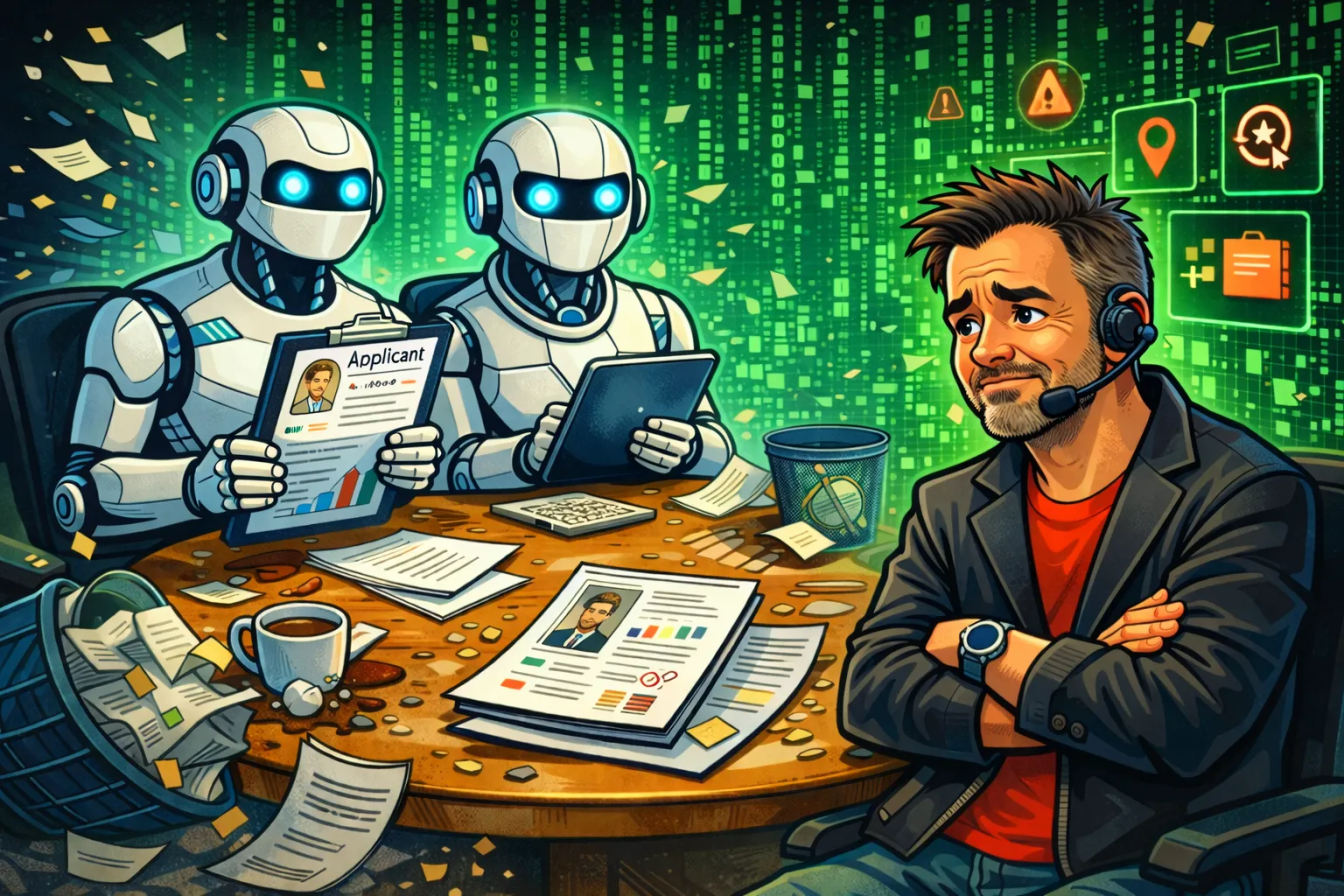
Most (Lets be real ALL) medium and large organizations now route resumes through algorithms before a human ever sees them. Gaps are auto-flagged. Non-linear movement is interpreted as volatility. Entrepreneurial chapters are quietly risk-weighted. The system is not asking who you are becoming. It is asking whether your sequence resembles clusters that performed well before.
And that distinction matters more than most professionals realize.
Take my own path, not for drama but for relentlessly real data:
Creative → Marketing manager → Consultant → Director → Global sales & marketing → CEO → Fractional CMO → VP → Stay-at-home dad → Director again → Cancer survivor → Founder.
To a human in a room, that can be a story of reinvention, recalibration, and pattern-breaking growth.
To an algorithm, it is simply variability.
The system sees title shifts, employment gaps, geographic moves, and role resets. It does not see the deliberation behind leaving stability. It does not see the maturity earned in seasons that do not fit neatly on a timeline. It does not see the clarity that arrives when you are forced to reconsider time itself.
Those invisible chapters — the exact experiences that produce adaptive intelligence — do not translate cleanly into structured fields.
And as evaluation becomes increasingly automated, structured fields matter more.
Founders and builders tend to carry traits that traditional organizations — and the algorithms trained on decades of traditional data — quietly penalize.
They leave when growth plateaus.
They question systems instead of optimizing comfortably inside them.
They prioritize leverage over security.
They are willing to reset publicly and own the outcome.
They bring an ownership mentality into every room.
These are the same qualities organizations claim to want when markets turn unstable.
They are also the qualities that look disruptive inside systems optimized for predictability.
AI screening is extraordinarily efficient. It reduces friction. It accelerates sorting. It narrows pools quickly. But efficiency introduces compression. When we compress human complexity into historical patterns, we inevitably filter out those who do not resemble the past.
And builders, almost by definition, do not resemble the past.
There is a growing tension in the modern labor market.
The people most comfortable building new systems are often the least comfortable operating inside rigid ones. And as hiring becomes increasingly data-driven, unconventional builders may find themselves quietly filtered out before conversation even begins.
Less hireable does not mean less capable.
It simply means harder to categorize.
The best candidates in a room have often been the ones who required explanation — the ones whose paths did not line up cleanly but revealed depth when explored. As friction disappears from hiring, so does some of that exploration.
And with it, some of the serendipity.
Follow this logic forward and the labor market begins to divide into two tracks.
On one side are operational excellence organizations staffed by highly predictable, highly specialized professionals whose career arcs align cleanly with statistical models. These companies will run stable systems exceptionally well.
On the other side are adaptive ecosystems built around founders, fractional leaders, and framework builders who move fluidly across industries, problems, and structures. These individuals may not fit neatly into algorithmic filters, but they excel at redesigning systems when stability fractures.
Both tracks are necessary.
But they are evaluated by entirely different logic.
As AI becomes the default gatekeeper, the human conversation that once allowed unconventional professionals to explain themselves is shrinking. The friction that allowed narrative to survive is thinning.
There is something sobering about realizing that entire chapters of your life would likely be auto-rejected by the very systems now marketed as improvements.
Stay-at-home parent.
Cancer survivor.
Fractional roles.
Geographic pivots.
Title resets.
None of these data points reflect competence.
All of them alter pattern classification.
Yet the lived experience inside those seasons is precisely what produces the perspective organizations claim to want when disruption hits. The machine measures sequence. It does not measure recalibration.
This does not make AI malicious.
It makes AI incomplete.
The issue is no longer whether resumes are dead.
The issue is whether we are intentionally designing evaluation systems that filter out the very people capable of redesigning the future when the map changes.
If you optimize exclusively for predictability, you will build stable organizations that struggle the moment stability is threatened.
If you deliberately create space for adaptive builders — even when their résumés look “messy” to the algorithm — you invite friction. You also invite reinvention.
The next couple of years will separate leaders who understand this distinction from those who do not.
The future may not belong to the professionals who score highest in the system.
It may belong to the ones who recognize when the system itself needs to be rebuilt.
Founders may become less hireable inside rigid, AI-filtered environments.
But the organizations — and economies — that learn how to engage them intelligently may discover they are more valuable than ever.
About the Author
Andrew Bloo is a leadership consultant and the creator of the HITSLeadership™ framework. He works with founders, executives, and operators who are tired of reactive leadership and burnout-driven culture, helping them build clarity, steadiness, and trust through practical leadership systems. Andrew focuses on leadership under real pressure — when decisions are messy, people are human, and presence matters more than polish.
Authentic Growth, Career Stories, Hands in The Soil, Personal story