Before Undo. Before AI. We Just Had Redo.
How undo took the permanence out and put the pressure on
Forty years ago I was a bleached-headed skater kid in Northern California, which at the time felt like the center of something even if no one would have admitted that out loud, because when you’re fifteen you don’t say things like that — you just feel it in your chest and you assume the rest of the world must be beating the same way.
We were close enough to Tahoe to disappear into the powder chasing 2-plankers on our plank like snowboards and San Francisco to feel sub culture smashing at normal from beat up vans full of bands who looked like they hadn’t slept since the previous gig and sounded like they meant every word they were screaming. They played the college venues you know the ones that smelled like year old beer, your feet felt glued to the floor, and they brought more than music with them — they brought ideas.
Ideas stitched into back patches. Ideas spray-painted on concrete walls in back alleys. Ideas written in margins of notebooks and binder covers. Ideas that felt dangerous or brilliant or sometimes both.
I didn’t see the world exactly like my friends did, and I wasn’t the most radical kid in the room either, but even then I was aware — maybe overly aware — that ideas weren’t decoration, they were fuel. They changed how you stood. They changed who you stood with. They rearranged your sense of what was possible long before you had the vocabulary to explain it.
Marketing has always carried that same energy for me — that rush of a new idea hitting hard enough to make you rethink the room, the thrill of a new angle, a new market, a new design that cuts sideways instead of straight on. There’s rebellion in good marketing. There’s appetite. There’s motion.
Leadership… not so much.
Somewhere along the climb, especially late in the climb, leadership gets polished and careful and wrapped in risk language and forecasts and responsible tone, which is necessary, yes, but sometimes the energy drops and the fire gets managed instead of fed and new ideas become dangerous again.
The other day I stumbled across an old photo of me and a friend skating at the post office…, taken with one of those cheap black plastic cameras with the analog timer that ticked like it was counting down to something important, and I’m almost certain we propped it on a curb in a parking lot and ran back into frame trying to look like we didn’t care.


Back then if you wanted a photo you had to commit to it, which meant buying the film, loading it carefully, not wasting shots, and when it was done sliding that roll into a yellow-and-white envelope and dropping it in a mailbox and trusting some distant building full of humming machines and strangers to turn your tiny strip of negatives into something you could hold.
A week or so later it would show up.
And opening that envelope felt like scratching a lottery ticket — that rush, that half-second where you were sure you’d captured something iconic — only to discover it was your thumb across the lens or half your face or so dark you couldn’t tell who was who.
And that was it.
No undo. No retake. No slider to fix the light. No smoothing out the version of yourself you weren’t thrilled about.
You got what you got and you lived with it and accepted the reality.
There was friction in everything, and that friction gave the moment weight.
Now I can take that same photo, feed it into a machine, and say make me younger, make me leaner, move the light, clean the background, give me perfect hair, make it cinematic, make it legendary, and I can watch it happen in real time and adjust and re-adjust until the version of me on the screen feels more aligned with how I’d prefer to be seen or even remembered.
We get to control how the sausage is being made now. We get to argue with reality until it gives in. We get to ask AI to make it fit our version of reality.
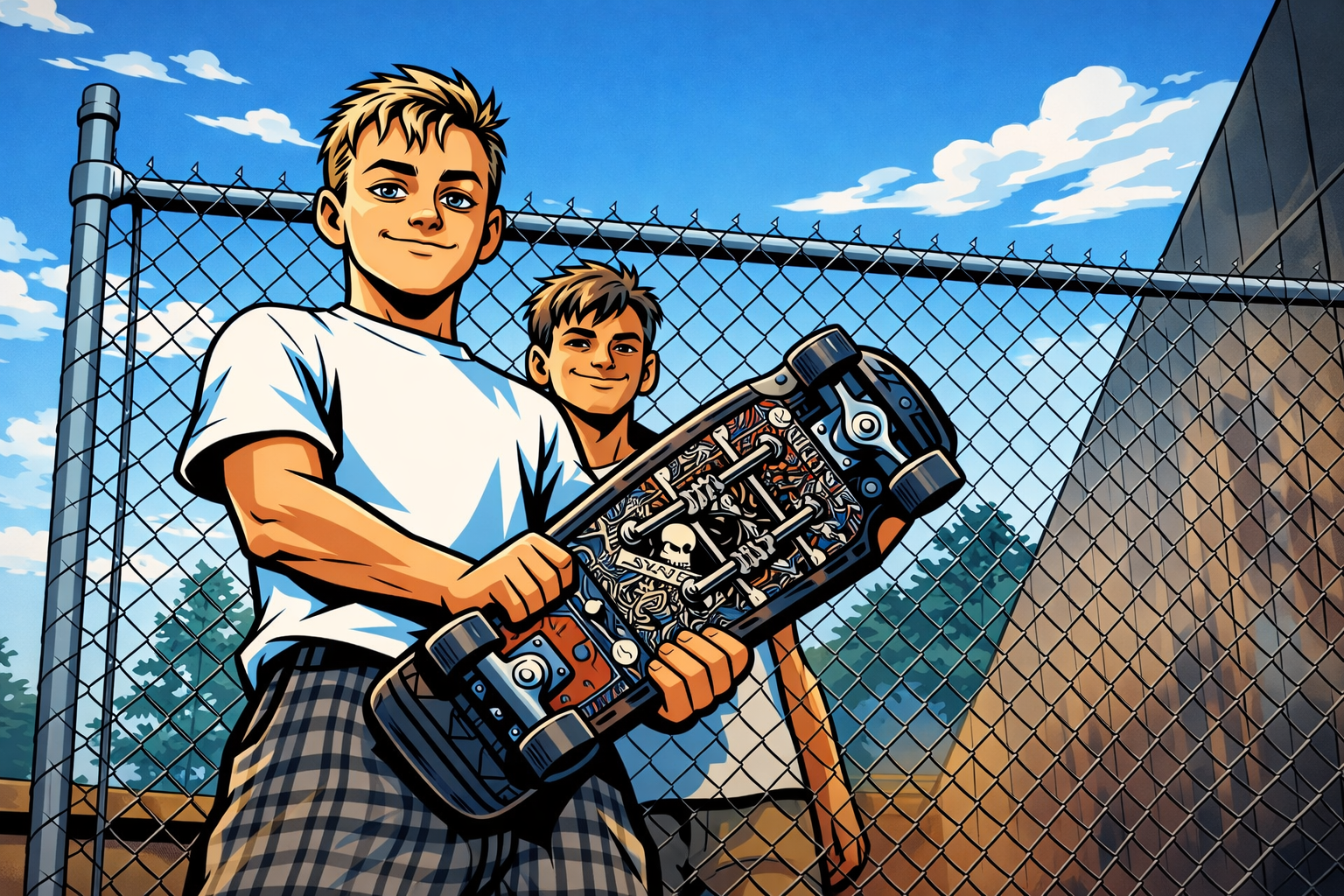
When that old picture popped up, I saw something clean and unedited — a skateboard, a friend, and me — and that was enough and that was cool. It wasn’t optimized. It wasn’t curated. It was just… two kids frozen in imperfect time.
And what did I do?
I fed it into AI and asked it to turn me into a character.
Of course I did.
We’re living in strange times where we can bend almost anything, including ourselves, and I’m not naïve enough to pretend I’m above it, because I use the tools and I push the buttons and I play the game just like everyone else.
But I can’t shake the thought that something subtle gets lost when everything can be refined instantly.
Waiting used to make things valuable. Scarcity made you care more. Imperfection made things honest.
And maybe that’s what late-stage leadership sometimes lacks — not intelligence, not experience, but friction — the kind that forces you to sit with an idea before you publish it, the kind that doesn’t let you rebrand yourself every quarter, the kind that makes you commit to the shot before you know how it will turn out.
That bleached-headed kid didn’t know it then, but those scraped knees from failed ollies and those nights spent arguing about lyrics that felt like manifestos and those mountains that taught you to dig in when your legs are burning were planting something deeper than rebellion — they taught endurance, and commitment, and the strange value of resistance.
Years later, sitting in boardrooms that felt a little too climate-controlled and watching organizations chase optimization like it was oxygen, I kept circling back to the same quiet realization that the most resilient teams weren’t the ones that eliminated friction, they were the ones that understood how to work with it — how to till the soil instead of paving it over.
I didn’t wake up one morning and decide to invent a framework.
I kept noticing that the lessons from cheap cameras and scratched-up decks kept resurfacing in places that wore suits and spoke in metrics — friction first, roots before results, presence before polish — and over time those observations took shape in what I now call HITSLeadership™.
Hands In The Soil – Its authentic, real and often dirty.
Not because it sounds good, but because leadership, like soil, only produces something real when you’re willing to get into it, to turn it over, to let air in, to let things rest when they need rest and push when they need pushing, to understand that regeneration isn’t the opposite of growth but the precondition for it.
It isn’t a rigid checklist and it isn’t a silver bullet and it certainly isn’t an excuse to slow down progress; it’s a reminder that sustainable impact grows from resistance worked properly, not from friction avoided entirely.
Those unedited photos and those ideas spray-painted on concrete and the thrill of committing without an undo button didn’t just make good memories — they built conviction, and conviction has muscle memory, and muscle memory is what keeps leaders steady when everything around them can be endlessly adjusted.
I don’t want to go backward.
But I don’t want to live in a world where nothing has to endure resistance either, because resistance is what gives ideas muscle and what gives identity spine and what turns noise into conviction.
Maybe the real trick in these strange, instantly adjustable times is not rejecting the tools, but remembering what it felt like when you couldn’t undo everything, when a bleached-headed kid and a 35mm camera were enough, when the moment stood on its own, when you had to wait long enough to mean it.
About the Author
Andrew Bloo is a leadership consultant and the creator of the HITSLeadership™ framework. He works with founders, executives, and operators who are tired of reactive leadership and burnout-driven culture, helping them build clarity, steadiness, and trust through practical leadership systems. Andrew focuses on leadership under real pressure — when decisions are messy, people are human, and presence matters more than polish.
Authentic Growth, Hands in The Soil, Marketing Truth, Personal story, Thought Leadership